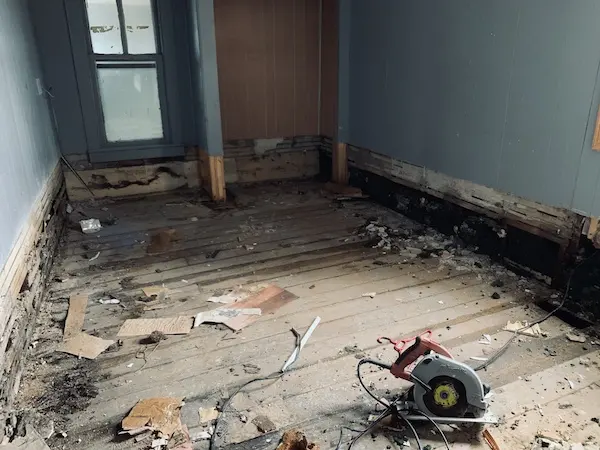
In a single-level house, a split supply pipe has nowhere to go but across the floor and into the walls. In the first hour, a few calm steps keep a small leak from turning into a whole-house loss.
Key takeaways
- The median Ralston home was built in 1972, and 702 homes were built in the 1960s and 655 in the 1970s, so many houses have decades-old plumbing.
- The main shutoff is the first thing to find and close, before anything else.
- Keep power and water apart: turn off breakers only from a dry spot.
- Move the contents that can be moved, then photograph the room before the crew starts.
- Moisture readings decide where walls are opened, so not every wall gets cut.
Why ranch homes get hit hard
Ralston has 2,987 housing units, with 1,902 detached single-family homes. Neighborhoods such as Bay Meadows are mainly single-family ranch homes, and Mockingbird Hills is a midcentury ranch-style neighborhood.
On one level, the water has the whole footprint of the house to spread across. A burst pipe in a wall or ceiling can reach every room in minutes.
The Bay Meadows area sits near Oak Park, Ralston Park and Bay Meadows Park, and the same single-level layout repeats through much of the city.
- Water spreads across the full footprint of the home.
- Flooring, baseboards and the bottom of the walls are wet first.
- Insulation in wall cavities pulls water upward.
- Furniture and stored items on the floor soak up the rest.
Step one: find the main shutoff and close it
Water service in Ralston comes from M.U.D., and the shutoff for the house is usually where the supply enters. Know where it is before the day you need it.
Close it fully. If the leak keeps running after the main is shut, the source may be a water heater tank or a pipe that is still draining.
- Turn the main shutoff clockwise until it stops.
- Open a faucet at the lowest point to drain the remaining water.
- Shut off the water heater supply if the leak is near it.
- Take a quick photo of where the water is coming from.
Step two: power and safety
Water and electricity do not mix. If water is near outlets, a panel or a light fixture, turn the power off, but only from a dry spot.
If the panel itself is wet or the floor around it is flooded, stay out and wait for a professional.
If you are unsure whether it is safe to touch the panel or the floor near it, stop and wait. A delay costs less than an injury.
What to avoid
Do not use a regular vacuum on standing water. Do not step into water near the panel.
Gas and heat
About 1,922 Ralston households heat with utility gas. A burst pipe near a furnace or water heater is a reason to be careful and let the pros check the area.
Step three: move contents and document
Get what can be saved off the floor. Rugs, small furniture, boxes and electronics go first.
Photograph the room before and after you move things. Wide and close pictures are both useful.
Keep a short written list as you go. Memory fades fast after a stressful hour, and a list is easy to hand to the crew and the insurer.
- Lift rugs and loose items to a dry area.
- Put foil or blocks under furniture legs that must stay.
- Take photos of the source, the water and the damage.
- Write down the time the pipe burst and when the water was shut off.
What the restoration team does next
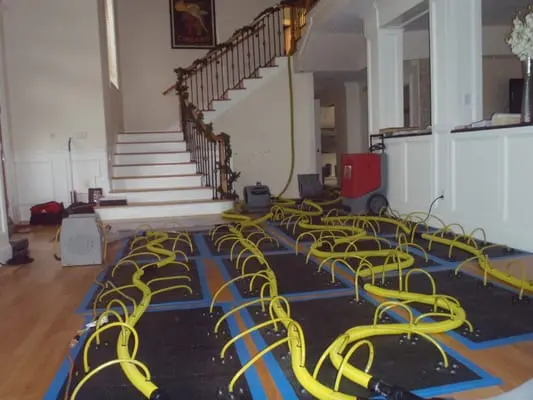
The crew begins with extraction, then moves to mapping the damage. Emergency water extraction takes standing water out before it wicks into drywall and subfloor.
Moisture readings show where the water went. Walls are opened only where readings say, which keeps the repair smaller and the cost lower.
The full process is on the Ralston burst pipe water damage page.
Wet carpet and pad are usually removed because they hold water against the floor. Hard flooring is checked board by board, since water can sit underneath it.
- Extraction of standing water.
- Moisture mapping with meters and a thermal camera.
- Removal of wet insulation, pad and damaged drywall.
- Air movers and dehumidifiers set up for drying.
- Readings repeated until the structure is dry.
Finding the cause and making the repair
After the water is under control, a plumber repairs or replaces the failed pipe or fitting. The drying team and the plumber are separate jobs.
In a house with decades-old plumbing, one failure can be a sign of others. The Ralston water damage restoration page shows how the local jobs are handled.
It is worth asking the plumber to look at nearby fittings and valves.
- Ask the plumber what failed and why.
- Ask whether nearby pipes show the same wear.
- Keep the invoice and photos of the failed part.
- Give the claim file a short written note of the cause.
Insurance and the claim file
A sudden burst pipe is often covered under a homeowners policy, but that depends on the policy, so check with your own insurer.
A clear file helps either way, because the insurer will ask when the pipe failed, how fast the water was stopped and what was damaged.
- Dated photos of the source and the damage.
- A list of damaged contents with rough ages.
- Receipts for emergency work and repairs.
- A short timeline of what happened and when.
Questions
What is the first thing to do when a pipe bursts?
Shut off the main water valve. Then turn off power to wet areas from a dry spot, move contents and photograph the damage.
Who provides water in Ralston?
Metropolitan Utilities District of Omaha, known as M.U.D., provides water to Ralston under a franchise agreement.
Will the crew cut open every wall?
No. The team uses moisture readings to decide where walls are opened, which keeps the work to areas that are actually wet.
Is a burst pipe covered by insurance?
It depends on the policy. Sudden pipe failures are often covered, but check your own policy and ask your insurer.
Do old houses burst pipes more often?
Older plumbing can wear out, and the median Ralston home was built in 1972. That does not mean every house has a problem, but it is a reason to know where the main shutoff is.
Should the water heater be turned off too?
If the leak is near the water heater, or the heater is under water, shut off its supply and its power or gas control. If the situation is unclear, leave the area and let a professional check it.
How fast does water spread in a one-level house?
Very quickly. With no upper floor to confine it, water spreads across the floor and into the base of the walls, so the main shutoff is the first move.